




Bedside tables
The bedside table is often the last piece of furniture we choose, even though it is one of the most used every day. It holds the lamp, the evening book, the alarm clock or the phone, and it is also what gives the sleeping area its visual balance. Well chosen, it simplifies daily routines and naturally completes the rest of the bedroom furniture. This page helps you compare formats, materials and storage types, to find the bedside table that truly matches your bed, your space and your habits.
Why does the bedside table remain a key anchor in the bedroom?
We barely notice it, yet we use it every day, morning and evening. The bedside table plays a double role: it serves everyday needs and it visually structures the space around the bed.
Keeping your lamp, book and essentials within reach
The first role of a bedside table is practical: holding a reading lamp, keeping a book you have started, a glass of water, your glasses or your phone on charge. Without it, these items end up on the floor or on the bed, and the sleeping area quickly loses comfort. A sufficiently wide top, possibly completed by a drawer or an open compartment, keeps the essentials accessible without having to get up. It is a simple criterion, but one that genuinely changes daily life: a well-sized bedside table avoids unnecessary movements and makes evenings more peaceful.
Structuring the sleeping area without hindering circulation
Beyond storage, the bedside table visually defines the space around the bed. A pair of matching bedside tables frames the bed and gives an immediate sense of order, even in a simple bedroom. Conversely, a model that is too bulky can obstruct passage, especially in a compact room where every centimetre of circulation counts. The goal is to find the right balance: a piece present enough to structure the sleeping area, yet discreet enough to let the room breathe and make cleaning around the bed easier.
How to choose a bedside table suited to your bed?
Before looking at style, start with dimensions and use. A successful bedside table is first of all one at the right height, with the storage that matches your habits.
Adjusting height, width and depth to your bed
The most useful rule is simple: the top of the bedside table should sit roughly level with the mattress, or slightly above. Too low, it forces you to lean over; too high, it becomes uncomfortable to reach for an object while lying down. So check the total height of your bed, base and mattress included, before choosing. Width should then be considered according to the space available on each side of the bed: ideally allow enough room to move around and open a drawer. Finally, depth affects both storage capacity and footprint in the room: a compact model suits narrow bedrooms better.
Choosing between drawers, an open compartment and a minimalist top
The type of storage depends on what you actually put down in the evening. A closed drawer keeps the top tidy and shields personal items from view: chargers, notebooks, medication. An open compartment makes books and magazines easy to reach, while adding visual lightness. The top alone, finally, suits people who like clear surfaces and only need a lamp and an alarm clock. Many models combine two of these solutions, for example a drawer topped by an open compartment, which offers a good compromise between order and everyday accessibility.
Wood, rattan or a wall-mounted version: which style for your bedroom?
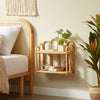
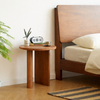
Material and format set the tone of the room. A wooden bedside table remains the safe choice: warm, easy to pair with bed linen and other furniture, it moves effortlessly through changing trends. If you are looking for a particularly robust piece, built to last, solid wood bedside tables offer superior stability and authenticity, with a grain that makes each piece unique. For a softer, more natural mood, a rattan bedside table brings the texture of cane weaving and a welcome visual lightness to bright bedrooms. Finally, in small spaces, the wall-mounted bedside table frees up the floor entirely: fixed to the wall, it eases circulation and cleaning while keeping the essentials within reach. There is no absolute right or wrong choice: the most relevant style is the one that fits the existing mood of your bedroom and the space actually available around the bed.
One last useful guideline: the number of materials in the room. A bedside table always introduces a texture, wood, weaving, lacquer, and this texture must converse with those already present: bed linen, curtains, rug, headboard. Two to three dominant materials are enough to compose a rich bedroom without confusion. If you are starting from a very neutral room, the bedside table can precisely become the element of character: cane weaving, a pronounced grain or a deeper wood tone are enough to wake up the whole. If your bedroom is already decorated, choose instead a model that extends what exists rather than competing with it. In both cases, keep in mind that the bedside table is mostly seen from the bed and from the door: judge it from these two viewpoints rather than in an isolated photo.
How to harmonise your bedside tables with the rest of your bedroom furniture?
A successful sleeping area rarely comes down to a single piece: it is the coherence of the whole that creates harmony. The first reference point is the headboard. If you already own a headboard, choose bedside tables in a similar shade or a deliberately contrasting one, but avoid half measures that give an impression of randomness. A wooden headboard pairs naturally, for example, with light wood or rattan bedside tables, for a soft, coherent bedroom with Scandinavian inspiration. Second reference point: proportions. Two identical bedside tables on either side of the bed suit symmetrical bedrooms; a single bedside table, or two different models of the same height, works well in more constrained spaces. Finally, think about the decoration placed on top: a lamp from the same family on each side, a book, a small object, and nothing more. A clear top highlights the material of the piece and makes the bedroom visually calmer. In short, choose the right dimension first, then the storage that matches your evenings, and finally the material that converses with your headboard: in that order, it is hard to go wrong.
Before confirming your choice, take three measurements: the total height of your bed including the mattress, the width available on each side of the bed, and the maximum depth that circulation can absorb. Then note what your bedside table actually holds each evening, not what it should hold in theory. These five minutes of preparation are worth all the hesitation: they turn a decorative purchase into an organisational choice, and that is exactly what a good bedside table should be, a discreet piece that serves you every day, for years.


