


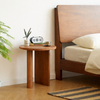


Floating Bedside Tables
When every centimetre counts, floor space becomes the bedroom's most precious resource. The floating bedside table starts from this simple observation: by mounting storage on the wall, it frees up the entire space beneath the unit, improves circulation around the bed and instantly creates a sense of lightness. Among our bedside tables, this is the format best suited to small bedrooms — though not exclusively: well positioned, a wall-mounted bedside table brings a refined style and genuine everyday comfort to any bedroom. This page will help you decide whether this format is right for you, where to install it and how to choose the right one.
Why choose a floating bedside table?
A floating bedside table does more than save space: it changes the way you live in and care for your sleeping area.
Free up the floor for a more open bedroom
A clear floor visually enlarges the room: the eye follows the floorboards without interruption, and the bedroom immediately feels more airy. This is especially noticeable in a small bedroom, where two floor-standing bedside tables can be enough to create a sense of clutter. The wall-mounted version retains all the functionality — a surface, a drawer or a niche for the lamp, book and phone — while eliminating the footprint. The bedside area remains fully equipped, yet feels open and unencumbered.
Easier movement and cleaning around the bed
The most tangible benefit is felt day to day: moving along the side of the bed is easier, you no longer bump into a furniture corner in the middle of the night, and cleaning becomes effortless — a vacuum or robot cleaner glides beneath the bedside table without any manoeuvring. For beds placed in narrow spaces, between a wall and the sleeping area for instance, this is often the only solution that allows you to keep bedside storage without sacrificing walkway space.
In which spaces is a wall-mounted bedside table most useful?
Three configurations make the most of it. Small bedrooms, first of all, where the space saving is immediate and where the minimalist style of the unit avoids visual overload. Rooms with sloped ceilings or unusual layouts, next: the mounting height can be adjusted freely, whereas a traditional bedside table imposes its standard height. Bedrooms with a clean, pared-back aesthetic, finally, where the floating effect of the wall-mounted unit naturally extends Scandinavian or contemporary lines. On the other hand, if your priority is generous storage capacity, a floor-standing bedside table — such as a wooden bedside table with drawers, or a solid wood model — will offer more room; and if you favour natural materials, a rattan bedside table placed on the more open side of the bed remains a beautiful alternative. Both approaches can even be combined in the same bedroom: wall-mounted on the narrow side, floor-standing on the open side.
How to position a floating bedside table correctly?
The success of a wall-mounted bedside table depends entirely on its installation: the right height and the right fixings guarantee comfort and safe everyday use.
Checking the height relative to the mattress
The rule is the same as for a traditional bedside table: the surface should sit level with the top of the mattress, or one to five centimetres above it. Measure the total height of your bed — base and mattress included — before drilling. This is precisely where the wall-mounted model has the advantage: you fix the unit at exactly the height that suits you, regardless of your bed frame. If you are installing a pair, also consider alignment: two bedside tables at the same height structure the wall behind the bed and reinforce a sense of order.
Matching the fixings to the wall and expected load
The drilling method must match the wall type: appropriate wall plugs for plasterboard, standard fixings for a solid wall. Next, estimate the actual weight the unit will bear: the bedside table itself, plus the lamp, books and everyday objects. Allow a comfortable margin, and check the fixings once the unit is loaded. Properly installed, a floating bedside table is perfectly stable; poorly fixed, it becomes the weak point of your sleeping area. A few minutes of preparation will save you any unpleasant surprises.
What storage to plan for without losing the floating effect?
The appeal of the wall-mounted format lies in its visual lightness: storage choices should preserve it. A compact drawer is enough for personal items — glasses, charger, notebook — and keeps the surface tidy. An open niche holds one or two books without closing off the volume. Avoid overloading the surface, however: on a wall-mounted unit, every object placed on it is more visible. If your storage needs around the bed are greater, the most elegant solution is to move storage to the headboard: a headboard with storage, or even a bookcase headboard for avid readers, pairs perfectly with a minimalist floating bedside table: everything within reach, the floor clear, and a bedroom that remains visually calm.
A final word on style: the floating format naturally accentuates the minimalist feel of the bedroom, but the material still matters greatly. A light wood model warms the wall and avoids an overly clinical look; a deeper tone creates a graphic contrast against a light wall. Because the unit appears to float, its underside is more visible than you might expect: opt for carefully finished surfaces on all sides, and align the tone with another element in the room — headboard, frame or chest of drawers — so that the bedside table feels considered as part of the whole, rather than added as an afterthought.
Nordlys floating bedside tables: space-saving design for everyday use
Nordlys floating bedside tables are designed for real-life use: surfaces sized for a lamp and an evening read, practical drawers and niches, stable materials and refined finishes in a Scandinavian spirit — understated and functional. Their compact design suits a small urban bedroom just as well as a pared-back master suite. Before choosing, measure the height of your mattress, identify the type of wall you have and define the storage you truly need: with these three reference points, a wall-mounted bedside table becomes one of the smartest choices you can make for your sleeping area. And if you are still undecided, start with just one side of the bed: you will quickly notice the difference in terms of circulation and cleaning, before deciding whether — or not — to fit the second side in the same way.


