




Wooden bedside tables
Among all bedside tables, the wooden version remains the easiest to live with: it warms up the sleeping area, matches almost every style of bed linen and ages well. But between light wood, walnut, caned fronts, a drawer or an open compartment, the differences are real in everyday use. This page helps you choose a wooden bedside table suited to your bedroom: the right shade, the right storage and the right proportions, for a piece that is useful every evening and consistent with the rest of your furniture.
Why choose a wooden bedside table?
Wood is the most common material for bedside tables, and that is no coincidence: it combines visual warmth, sturdiness and ease of pairing.
Bringing warmth next to the bed without overloading the room
The sleeping area is a space where we seek calm. Wood contributes to it naturally: its grain and its shade bring presence without any heavy-handed decorative effect. Unlike a lacquered or metal piece, a wooden bedside table softens the atmosphere and catches the light of a reading lamp beautifully. Even a compact model is enough to warm up a white wall or a bed with sober lines. This is what makes the material so well suited to Scandinavian-inspired bedrooms: it creates an enveloping atmosphere while remaining visually light.
Betting on a material that is easy to pair with linen and finishes
A wooden bedside table goes with almost everything: white bed linen, natural shades, deep colours, textured fabrics. That is a concrete advantage over time. You can change your duvet cover, repaint a wall or let your decoration evolve without the piece looking out of place. Natural, oiled or matt varnished finishes pair as well with one another as with other materials such as linen, wool or rattan. Choosing wood therefore means choosing a piece that will follow your bedroom's evolutions instead of constraining them.
How to integrate a wooden bedside table into your bedroom?
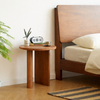
Start with the height: the top should sit level with the mattress or slightly above, so you can grab lamp and book without effort. Then check the space available on each side of the bed; a compact model preserves circulation in narrow bedrooms, while a wider format visually balances a large bed. In terms of style, the simplest approach is to match the shade of the bedside table to an element already present: the headboard, a chest of drawers, a frame. Two identical bedside tables create a soothing symmetry; two different models of the same height give a more personal result without breaking the harmony. Finally, let the top breathe: a lamp, a book, an object, and the wood does the rest.
Which storage should you favour according to your evening habits?
The right storage is not a matter of taste but of use: observe what you actually put down next to the bed each evening, and choose accordingly.
Closed drawers to keep the top tidy
If your bedside table tends to accumulate chargers, notebooks, creams or medication, a drawer changes everything. It keeps personal items away from view and dust, while leaving the top free for the lamp and the current book. It is also the most visually restful solution: a closed bedside table contributes to an orderly bedroom, where the eye stumbles on nothing. Simply check the depth of the drawer and how smoothly it opens, two details that make all the difference in daily use.
An open compartment for everyday essentials
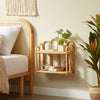
The open compartment suits readers and those who like their essentials visible and accessible. Stacked books, the current magazine, a natural-fibre basket: the compartment holds what is genuinely useful, with no handling required. It also lightens the silhouette of the piece, which is welcome in a small bedroom. For many, the ideal remains the combination of both: a drawer for what you want to put away, a compartment for what you want to keep within reach.
Light wood, walnut, cane webbing: which mood to create around the bed?
Light wood, oak or natural shades, visually enlarges the room and reinforces a soft, luminous atmosphere: it is the safest choice for a Scandinavian bedroom. Walnut, deeper, brings character and a slightly retro elegance; it works particularly well with ecru fabrics or coloured walls. Caned fronts, finally, combine the structure of wood with the texture of weaving: a beautiful bridge towards rattan bedside tables, for a natural bedroom without uniformity. And if your priority is robustness over time, turn to solid wood bedside tables, whose thickness and joinery are designed for lasting use. In a very compact bedroom, note that a wooden wall-mounted bedside table combines the warmth of the material with the space savings of wall fixing.
How to compose a coherent ensemble with headboard and chest of drawers?
The coherence of a bedroom comes down to just two or three pieces of furniture. The most structuring duo is the bedside table and the headboard: a wooden headboard in a shade close to your bedside tables immediately creates a considered ensemble, with no additional decorative effort. Then adapt to the width of the bed: for a 160 cm bed, a 160 wooden headboard leaves room for two well-aligned bedside tables, while a 140 wooden headboard suits more compact bedrooms, with one or two narrow bedside tables. The chest of drawers does not need to be identical: a neighbouring wood shade and lines from the same family are enough to maintain harmony. Keep one simple rule in mind: no more than two visible wood species in the room, consistent heights around the bed, and clear tops. With that, your wooden bedside table will find its place naturally, today as in ten years' time.